-
![]()
Eerste Ronde 1.0
-
![]()
Eerste ronde 2.0
-
![]()
Triple 20
-
![]()
Triple 20 2.0
-
![]()
Laatste Ronde 1.0
-
![]()
Laatste Ronde 2.0
-
![]()
Laatste Ronde 3.0
-
![]()
D'earth
-
![]()
Darteritus
-
![]()
Darteritus 2.0

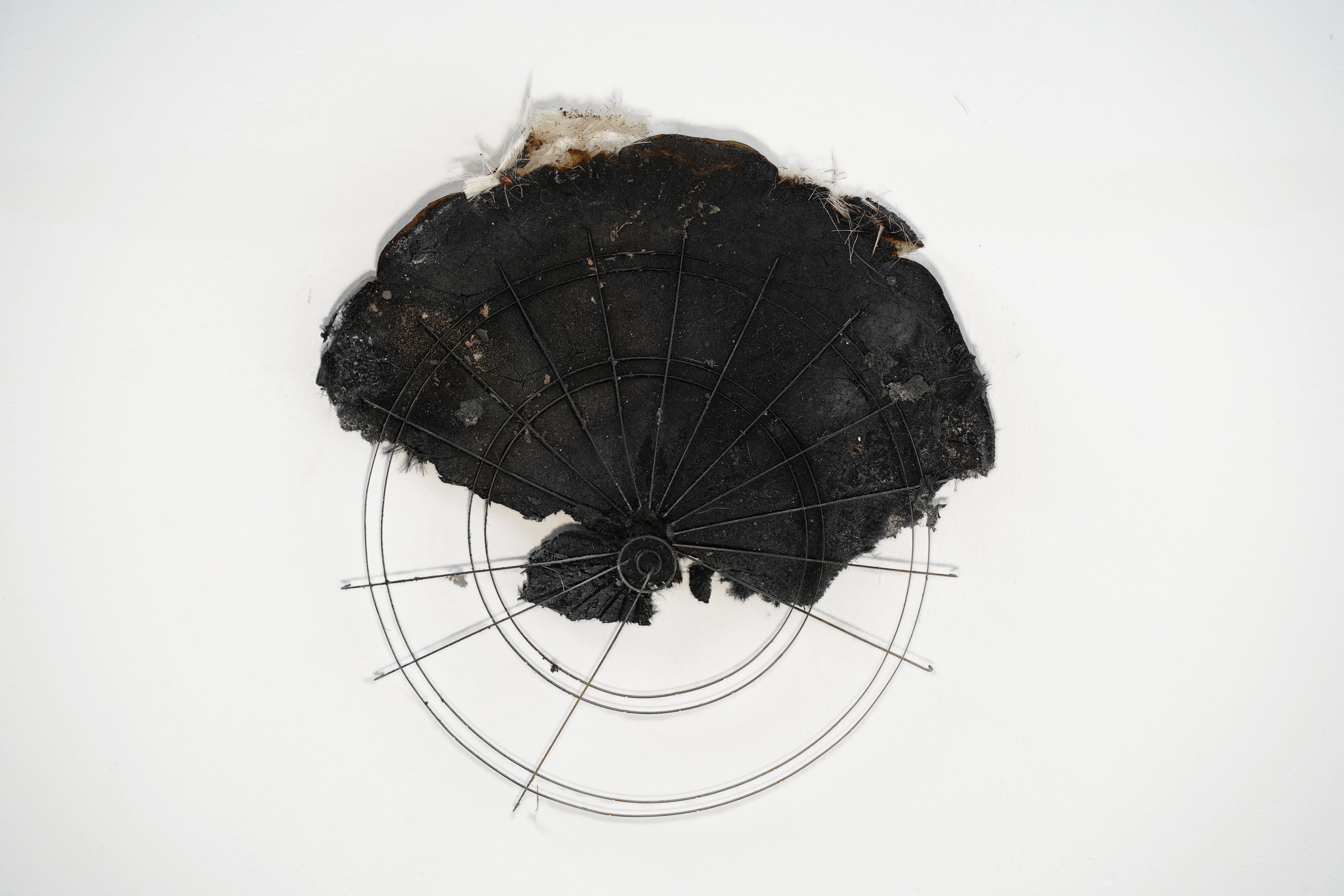
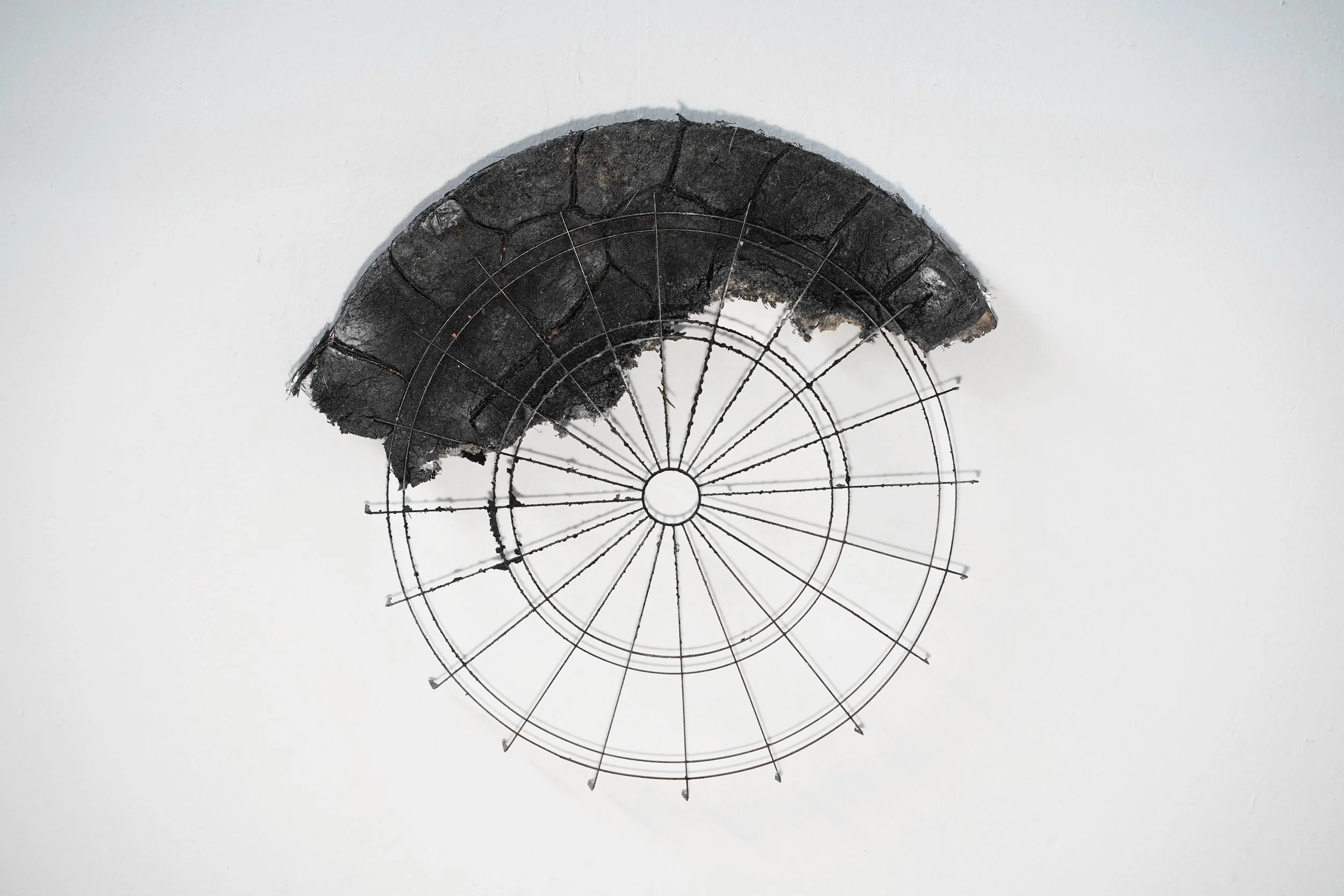

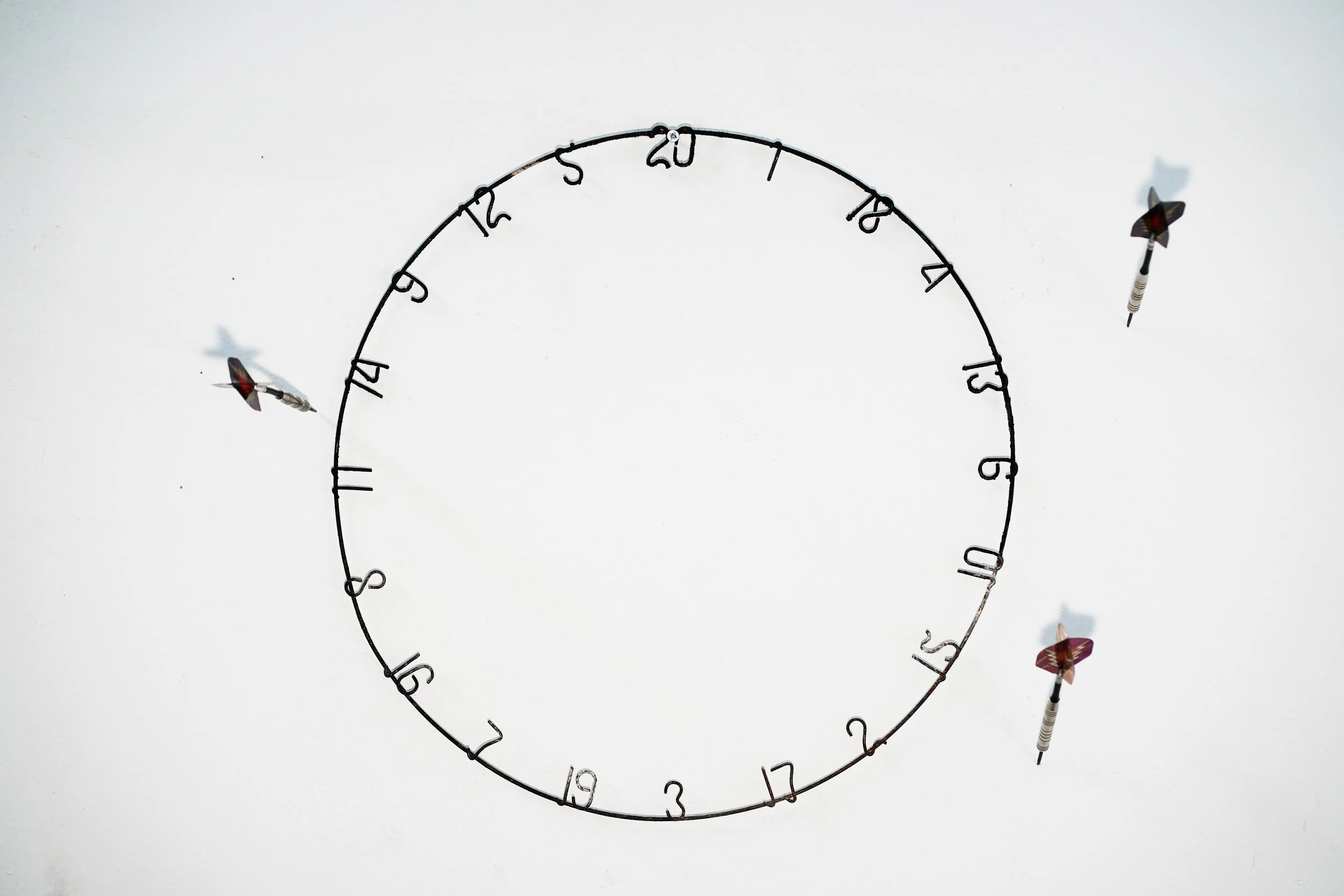
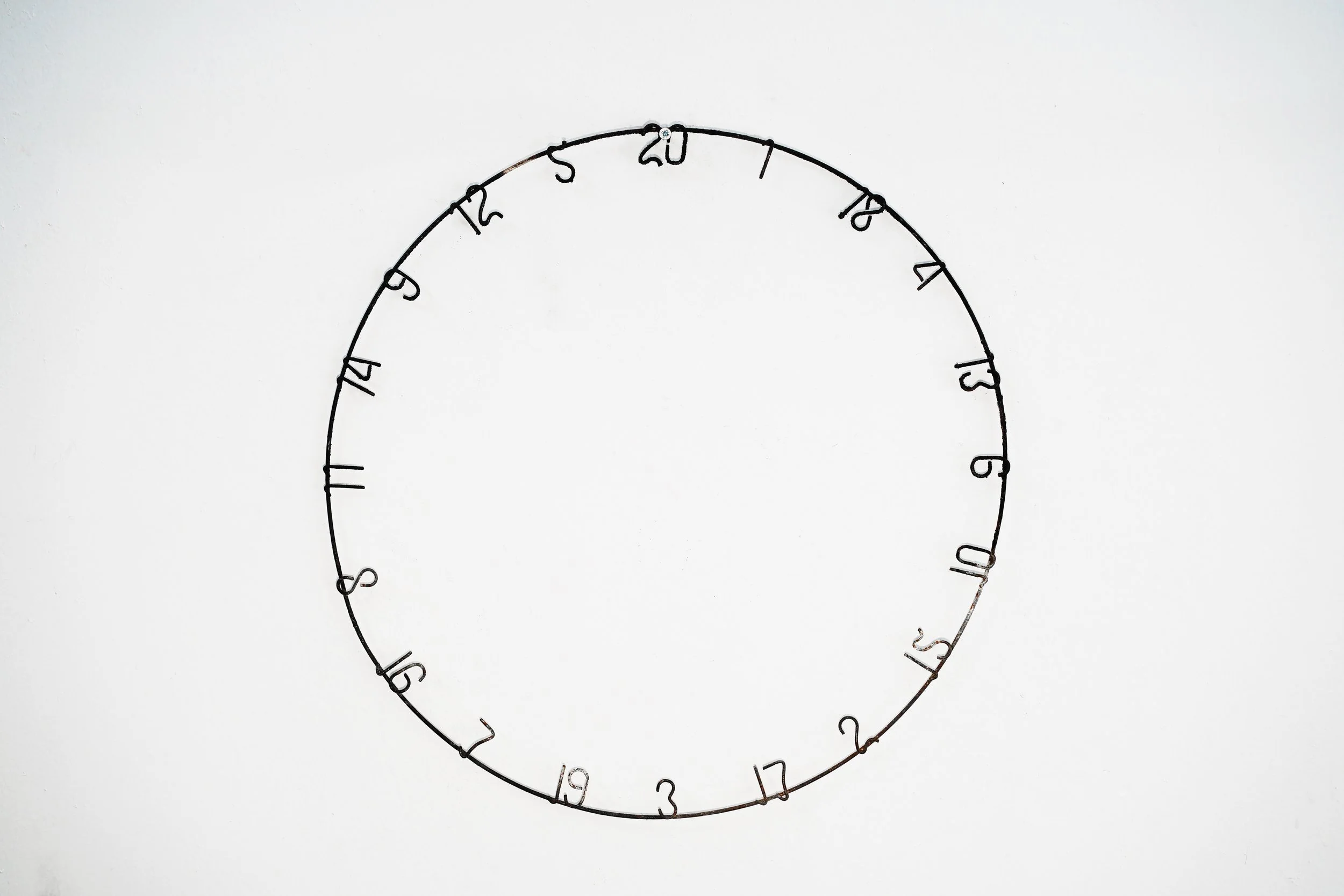

Darteritus series, 10 dartborden, 2026
Text written by Aurelien Bonnetaud on my Triple 20 series I showed recently at Het Acrhief in Rotterdam. English below.
[FR]
TRIPLE 20 SERIE
L'oeuvre est constituée d'une serie de cibles pour jeu de flechettes, de type sportif, voire "professionel". L'accrochage et la disposition de ces cibles varient en fonction des lieux et des expositions.
Ici, à Het Archief, nous faisons d'abord face à un premier accrochage de 7 cibles qui nous font face en arrivant. Une autre cible, nettement différente, est accrochée à proximité, sur un mur opposé. Le spectateur pour voir l oeuvre fait face a la cible en se placant instinctivement à une distance d environ 2m50. Ce placement renvoit directement au positionnement du sportif qui se prépare a lancer sa flechette. Cela implique une action mentale de projection de la part du spectateur : ici c est le regard qui est projeté ... Ce regard va naturellement chercher en priorité à viser le centre de la cible, c'est un conditionnement.
Les flêchettes sont à la fois un jeu et un sport qui n'a rien d'athlétique et qui ne semble requerir aucune competence physique particulère ; et cela donne l'idée que ce sport est trés accessible et facile, sans enjeu important et garant d'un succes relatif sans aucun entrainement.
La cible est assez grosse par rapport à la flechette, elle est donc en théorie facile à toucher. L'affaire se corse lorsque l'on cherche à atteindre un point précis : cela demande alors une grande maitrise et une grande concentration ( d'autant plus dans les tournois desormais mediatisé avec une foule bruyante, des jeux de lumière, un véritable show ).
Ajoutons aussi que le jeu de flechettes connait un reglement avec plusieurs variantes et des subtilités qui demandent une certaine specialisation de geste et de calcul mathématique. On ne joue pas au 501 comme on joue au cricket, par exemple. Les zones à atteindre impliquent de déployer des strategies de jeu adaptées et une capacité à savoir anticiper à plusieurs coups d'avance le chemin à emprunter pour atteindre avant son adversaire le score à obtenir pour emporter la partie. Cela est d'autant plus accentué car entre l'intention visée ( vouloir toucher un triple 20) et le resultat obtenu (finalement toucher 1 ou 5 ), il y a fatalement un décalage notable qui contraint le joueur a adapter sa stratégie en temps réel. Les ecarts de points d'une case à une autre ne suivent pas un ordre consecutif, cela augmente considerablement les écart de points en cas d'echec : 20 – 1 - 18 - 4 – 13 – 6 – 10 - ... Dans ce jeu, la moindre approximation peut avoir des consequences directes sur la victoire et l'atteinte du but ultime : remporter une partie, un tournoi, un championnat.
Malgré ses apparences bon enfant, le jeu de flechettes est donc bien un sport de concentration performatif au même titre que les autres disciplines de tir olympique ou de lancer d'objet. Chaque étape du geste à son importance, le but du sportif étant alors d'allier force, vitesse, précision et strategie d'adaptation.
Si l on considère la cible d'un point de vue symbolique, comme un but a atteindre, on peut y voir une metaphore du "succés" .
En cela, nous pouvons in extenso faire un parallele avec les structures sociales qui régissent les sociétés occidentalisées, capitalistes et performatives.
La cible en tant que structure nous propose un modèle de victoire à atteindre le plus rapidement possible. Et cette victoire, a priori, nous semble aisée à atteindre : il suffit de bien viser. Le precepte est simple, chacun peut y acceder.
Notons au passage que pour le novice, la conception du meilleur coup a jouer pour marquer des points est erronée : ce n'est pas le centre ( 50 pts) qui présente la meilleur opportunité de score mais le triple 20 (60pts). Il s'agit là d'une volonté délibérée de ne pas placer la plus haute valeur du jeu au centre de la cible comme on pourrait logiquement s'y attendre. Ce contournement logique bernera sans aucun doute les personnes non initiées aux régles du jeu.
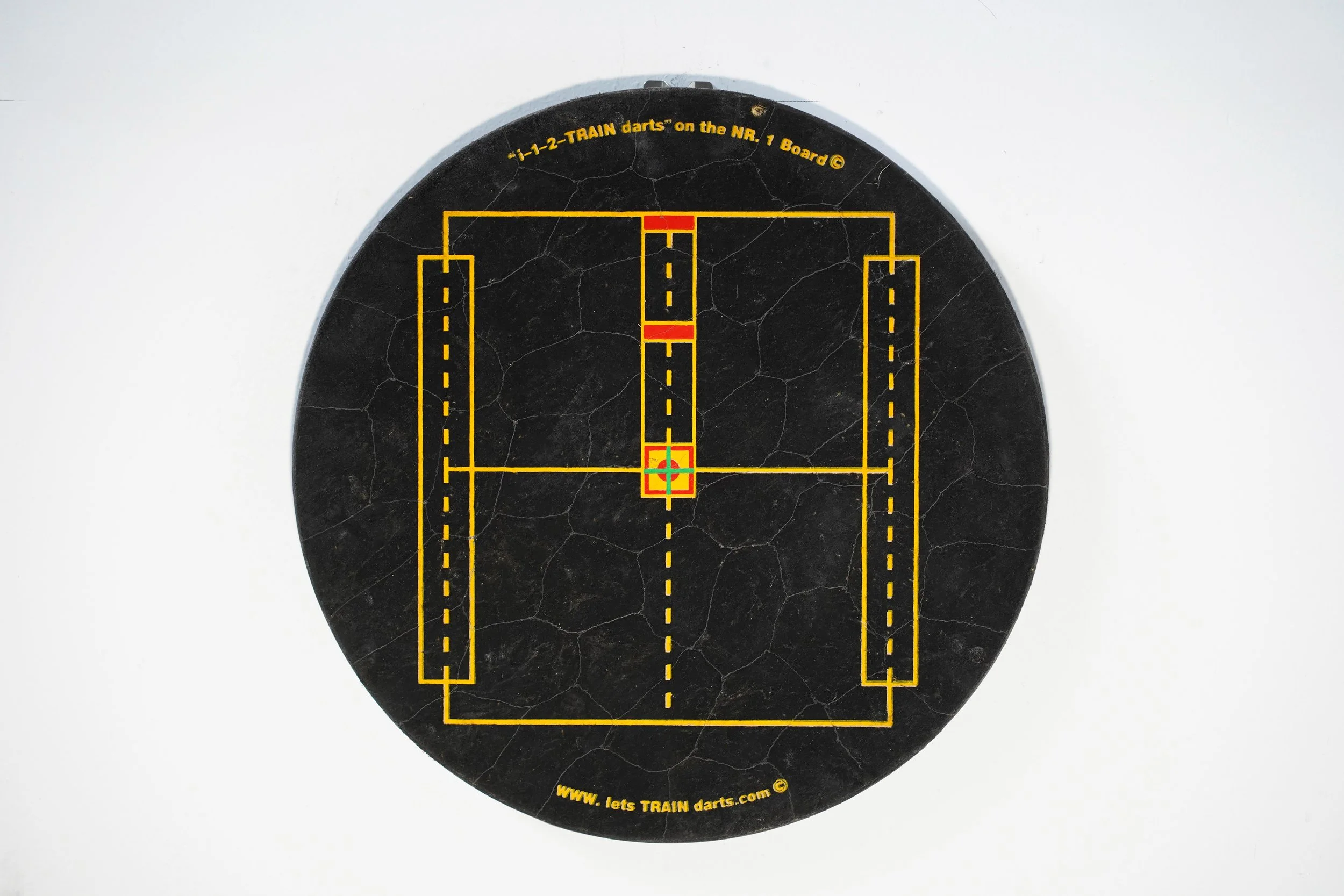
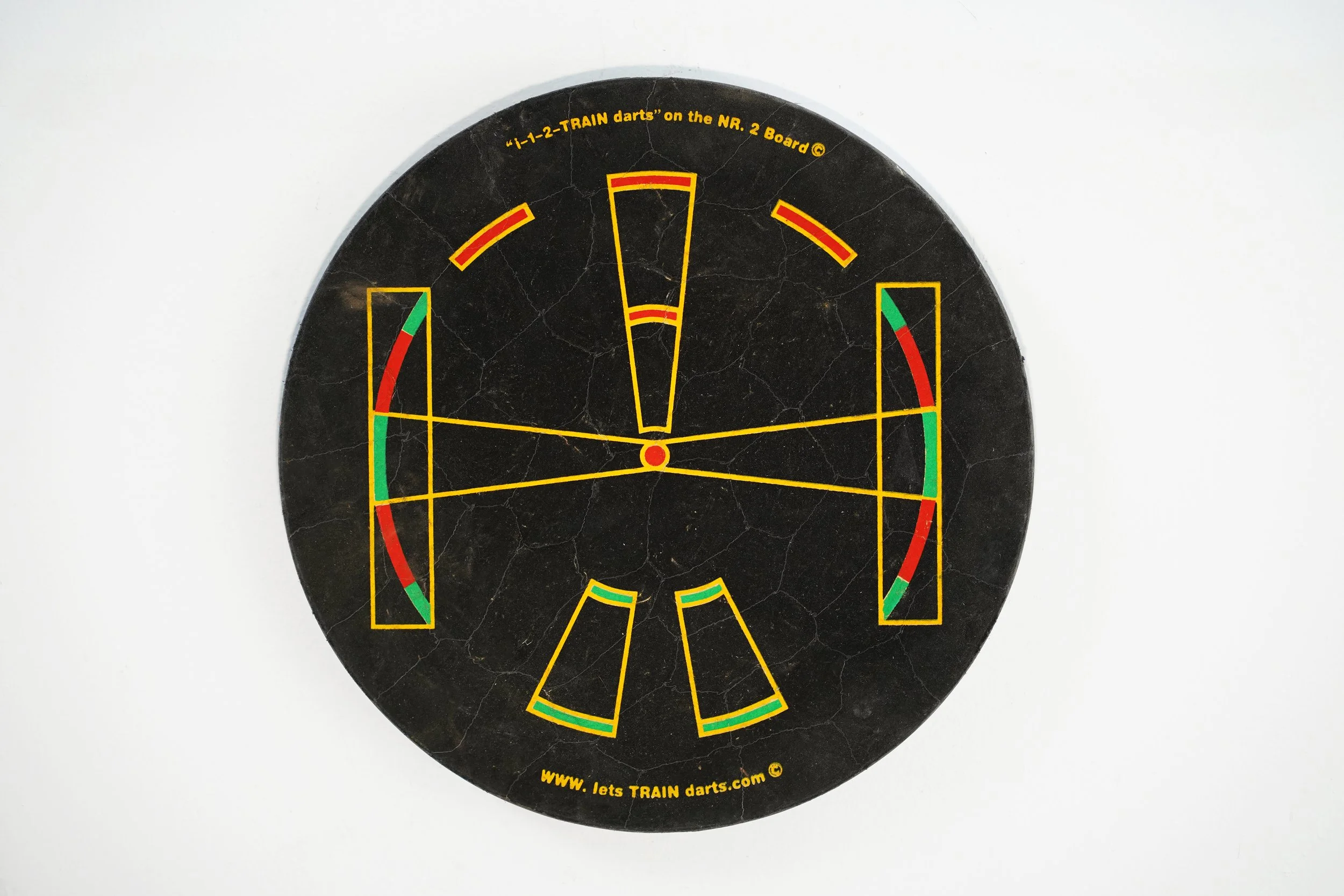
Dans cette exposition, les deux premieres cibles présentées gauche du mur sont des cibles d'entrainement. Elles ont été trouvées chez un fournisseur et sont exposées telles quelles ont été acheter, en ready made. Ces cibles d'entrainement aux motifs si particuliers sont des objets assez rares et peu connus du public. Motif d'une representation mentale inversement proportionné a ce qu'est celui de la cible performative en terme d archetype qui, lui, emerge aussitot dans l'esprit lorsqu'on évoque le terme "viser". Comme quoi, la promesse de l entrainement semble être moins interessant que celle de jouer directement sur une "vraie" cible.
En suivant l'accrochage actuel, nous passons donc logiquement aux "vraies" cibles.
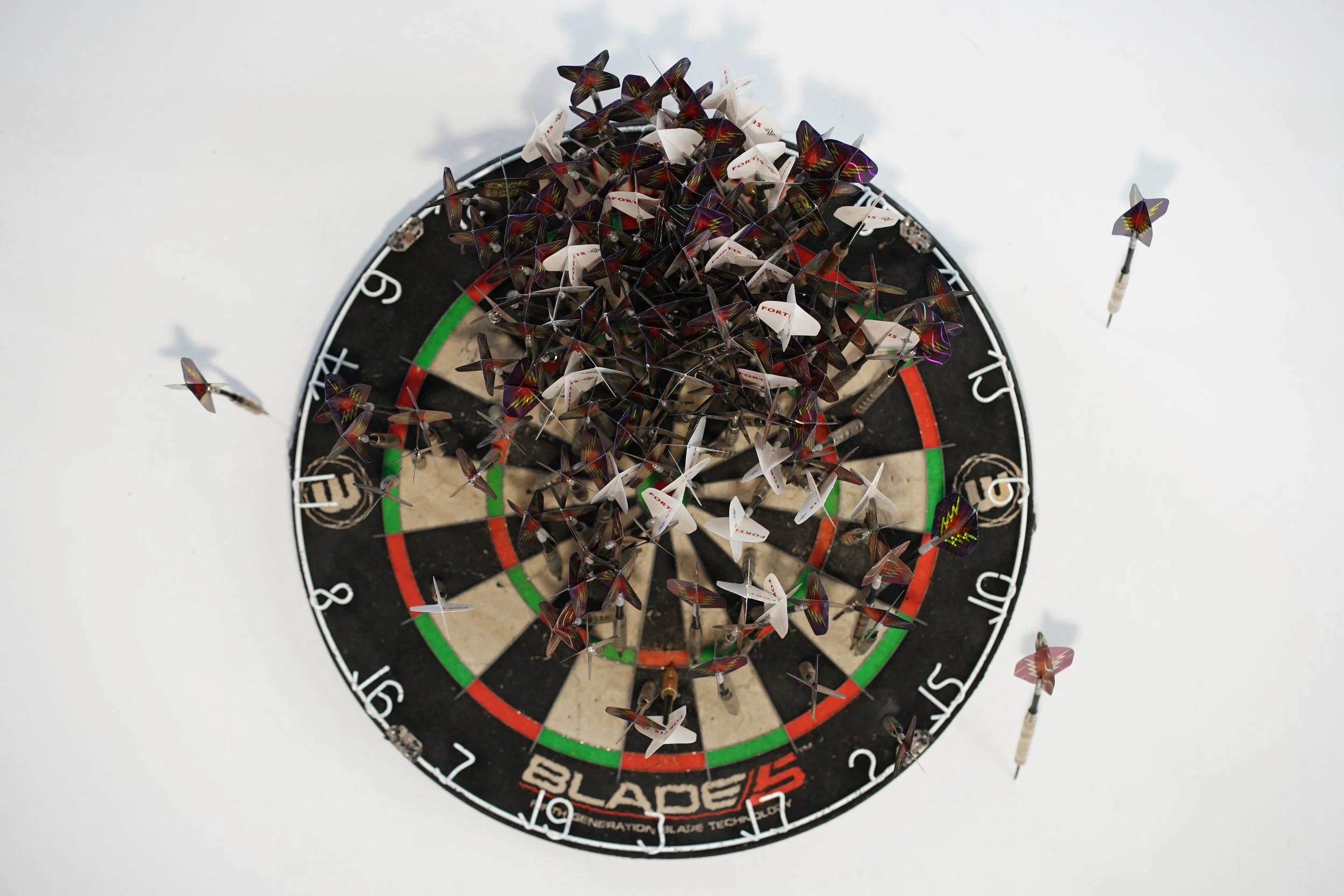
La premiere cible suivant les cibles d'entrainement est criblée de flechettes, au delà des normes du jeu [3 flechettes par tour] ce qui se raccroche donc a la notion de surperformance ou de suradaptation. Ici l objectif est rempli jusqu'à l outrance, jusqu'au point de saturation.
Si la cible est une metaphore du contrat social, alors nous y voyons l exemple de "réussite parfaite" : millionaires, milliardaires, stars, champions, ...
Le terrain est conquis et la cible saturée, le joueur a marqué son territoire jusqu'à quasiment exclure la possibilité de jouer sur la cible. L'espace de la cible étant saturé, il devient interessant d observer qu autour de cette surface quelques flechettes se sont egarées : sont-elles de simples erreurs de trajectoire, des dommages collateraux ou les premier signes d un epuisement?
Cette idée peut faire echo à une sequence à venir, présentant 3 cibles plus ou moins consumées par le feu.
Avant cela, comme point central de cet accrochage, nous voyons une cible d'aspect terreux. Nous y reviendrons par la suite.
La consumation ( consommation) progressive des cibles suivante devoile progressivement sa structure fondamentale et sa fragilité, à mesure qu'elle brûle on voit que tout cela ne tient qu a un fil et risque de s'ecrouler, de se desintegrer si lo'n poursuit l'idée de "performer" sur ce terrain et de continuer à jouer de la même manière que précedemment.
Si les régles du jeu sont restées les même, le terrain, lui , a changé. Il est détruit et ne represente plus l'idéal de victoire et de réussite tel qu'il le fut à la base : l' objectif devient alors obsolete et plonge le joueur / spectateur dans le non-sens.
Il ne reste alors qu'à renouveller ou réinventer le terrain.
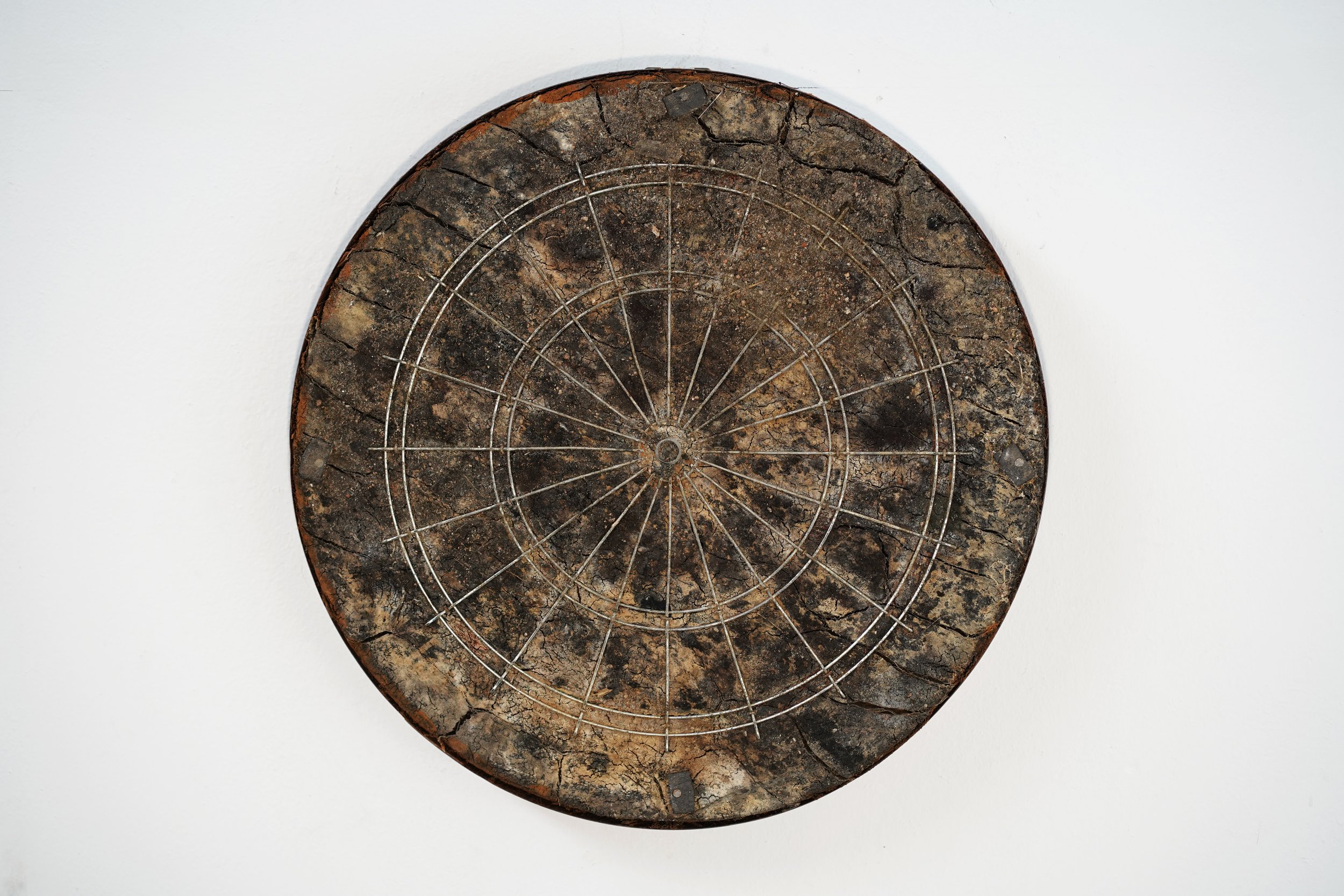
Nous retrouvons notre point central : une cible qui aprés un séjour dans la terre nous apparait modifiée, méconnaissable. Ici, le terrain performatif devient alors autre, les règles du jeu sont brouillées et n'ont plus la même valeur. La cible est devenue socle, matrice.
Une dernière cible présentée à part des autres, sur un autre plan, nous laisse supposer le devenir de cette matrice :Cette cible n'a plus qu'un lien tenu avec ce que fut autrefois son archetype de cible et son but de performance et de réussite.
Celle-ci est bien presentée accrochée au mur, a hauteur de jeu. Celle-ci a bien conservé sa forme ronde. Mais sa surface est devenue autre. Elle n'est plus lisse.
Le tracé des cases a disparu, la structure performative a disparue.
En lieu et place de ce terrain competitif se trouve une epaisse couche de terre d'où emerge difficilement une jeune et fragile pousse vegetale qui a pris racine dans ce terreau improbable :
il s'agit peut-être là symboliquement d'une renaissance, du fondement d'une nouvelle structure.
[EN]
TRIPLE 20 SERIES
The work consists of a series of dartboards designed for competitive, even “professional,” play. The mounting and arrangement of these dartboards vary depending on the venue and exhibition.
Here at Het Archief, we are first confronted with an initial display of 7 targets facing us as we enter. Another target, distinctly different, is hung nearby on an opposite wall.
To approach the work, the viewer faces the target, instinctively positioning themselves at a distance of approximately 2.5 meters. This positioning directly echoes the stance of an athlete preparing to throw a dart. This requires a mental act of projection on the part of the viewer: here, it is the gaze that is projected... This gaze will naturally seek first and foremost to aim at the center of the target; it is a conditioned reflex.
Darts is both a game and a sport that is not at all athletic and does not seem to require any particular physical skill; and this gives the impression that the sport is very accessible and easy, with no significant stakes and with a guarantee of relative success without any training.
The target is quite large compared to the dart, so in theory it is easy to hit.
Things get more complicated when you’re trying to hit a specific spot: that requires a high level of skill and intense concentration (especially in today’s televised tournaments with a noisy crowd, lighting effects, and a full-scale show). It’s also worth noting that darts has rules with several variations and subtleties that require a certain level of specialized technique and mathematical calculation. You don’t play 501 the same way you play cricket, for example. The targets to hit require the deployment of appropriate game strategies and the ability to anticipate several moves ahead the path to take in order to reach the score needed to win the game before your opponent does. This is all the more pronounced because between the intended target (aiming for a triple 20) and the actual result (ultimately hitting 1 or 5) there is inevitably a significant discrepancy that forces the player to adapt their strategy in real time. The scoring values from one segment to the next do not follow a consecutive order, which significantly increases the point gap in the event of a miss: 20 – 1 – 18 – 4 – 13 – 6 – 10 – ... In this game, even the slightest shakiness can have direct consequences on winning and achieving the ultimate goal: winning a game, a tournament, or a championship.
Despite its seemingly lighthearted nature, darts is indeed a high-performance sport requiring intense concentration, just like other Olympic shooting or throwing disciplines.
Each step of the throw is important, the athlete's goal being to combine strength, speed, precision, and adaptive strategy.
If we consider the dartboard symbolically, as a goal to be achieved, we can see it as a metaphor for "success." In this respect, we can draw a parallel with the social precepts and structures that govern Westernized capitalist countries and other performance-driven societies.
The dartboard, as a structure, offers us a model of victory to be achieved as quickly as possible. And this victory, at first glance, seems easy to attain: all you have to do is aim well. The principle is simple; anyone can achieve it.
One may notice that for the novice, the perception of the best shot to score points is flawed: it's not the center (50 points) that offers the best scoring opportunity, but the triple 20 (60 points). This is a deliberate choice to avoid placing the highest value in the game in the center of the target, as one might logically expect. This logical workaround will undoubtedly mislead those unfamiliar with the rules of the game.
In this exhibition, the first two targets on the left side of the wall are training targets. They were sourced from a supplier and are displayed as purchased, following Duchamps' ready-made logic. These training targets with their distinctive patterns are quite rare and little known to the public. The symbolic common representation of these “training patterns” - that nobody knows - is inversely proportional of the performance target patterns in terms of archetype, which immediately springs to mind when the word "aiming" is mentioned. This shows that the promise of practice darts seems less appealing than the prospect of playing directly at a "real" target.
Following this current pattern, we logically move on to the "real" ones.
The first target after the practice dartboards is riddled with darts, exceeding the game's standard [3 darts per turn], which relates to the notion of overperformance or over-adaptation. Here, the objective is fulfilled to an extreme degree, to the point of saturation. If the target is a metaphor for the social contract, then we see it as the epitome of "perfect success": millionaires, billionaires, stars, champions, etc ...
The territory is conquered and the target saturated; the player has marked that territory to the point of virtually eliminating the possibility of playing furthermore at the target.With the target area saturated, it becomes interesting to observe that some darts have strayed from this surface: are they simple trajectory errors, collateral damage, or the first signs of exhaustion?
This idea may foreshadow a future sequence, featuring three targets more or less consumed by fire [burnout]. Before this, as the central point of this confrontation, we see an earthy-looking target. We will return to this later.
The progressive consumption of the following targets gradually reveals their fundamental structure and fragility. As they burn, we see that everything hangs by a thread and risks collapsing, disintegrating, if we pursue the idea of "performing" on this terrain and continue playing in the same way as before. While the rules of the game have remained the same, the terrain itself has changed. It is destroyed and no longer represents the ideal of victory and success as it originally did: the objective then becomes obsolete and plunges the player/spectator into meaninglessness.
All that remains is to renew or reinvent the playing field. We return to our central point: a target that, after being buried in the earth, appears altered, unrecognizable. Here, the performative playing field becomes something else entirely; the rules of the game are blurred and no longer hold the same value : the target has become a new base, a matrix. A final target, presented separately from the others, on another plane, allows us to imagine the future of this matrix: this target now has only a tenuous link to what was once its archetype and its purpose of performance and success. It is still presented hanging on the wall, at playing height. It has retained its round shape. But its surface has become something else. It is no longer smooth. The lines of the scoring patterns have disappeared; the performative structure has disappeared. In place of this competitive terrain lies a thick layer of soil from which, with difficulty, emerges a young and fragile plant shoot that has taken root in this unlikely soil: this may symbolically represent a rebirth, the foundation of a new structure.